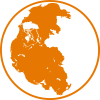
Tiguentourine Fm
Period:
Carboniferous, Permian
Age Interval:
Gzhelian – Artinskian
Province:
Murzuq Basin
Type Locality and Naming
The term Tiguentourine Formation was probably first introduced by de Lapparent and Lelubre (1948) for the lower part of their continental post Tassilien Group (Alkhalas, 2006). Named after the spring of Tiguentourine in Algerian territory (Mamgian, 1980).
Synonym:
References: de Lapparent and Lelubre, 1948; Burollet, 1960; Pierobon, 1991; Alkhalas, 2006
Lithology and Thickness
defined by Burollet (1960) as consisting of 'reddish brown to mauve clays and shales often slightly dolomitic, with characteristic gypsum beds near the base'. The thickness of this formation ranges between 130m and 520m in the subsurface (Pierobon, 1991).
Lithology Pattern:
Claystone
Relationships and Distribution
Lower contact
It is conformably overlain by Dembaba Fm.
Upper contact
It is unconformably overlain by the Zarzaitine Fm. (Hercynian unconformity - Aziz, 2000).
Regional extent
GeoJSON
{"type":"Feature","geometry":{"type":"Polygon","coordinates":[[[10.976,25.209],[12.169,25.606],[13.321,26.008],[14.39,26.376],[15.419,26.748],[16.2,27.199],[16.735,26.044],[17.105,24.852],[16.982,23.663],[16.53,22.58],[15.871,21.533],[16.036,20.708],[17.023,20.089],[18.175,19.575],[19.45,19.247],[18.628,18.748],[16.776,18.604],[14.761,18.661],[12.992,18.923],[11.84,19.515],[11.223,20.335],[10.812,21.372],[10.524,22.613],[10.359,23.904],[10.976,25.209]]]}}
Fossils
Age
Age Span:
Beginning stage:
Gzhelian
Fraction up in beginning stage:
0.00
Beginning date (Ma):
303.68
Ending stage:
Artinskian
Fraction up in the ending stage:
0.5
Ending date (Ma):
286.91
Depositional setting
Depositional pattern:
Additional Information
Compiler:
Enam O. Obiosio, Solomon Joshua Avong and Henry Nasir Suleiman (2024) - Stratigraphic Lexicon compiled from the following books: